

Detecting an Impending Threat from the Emerald Ash Borer
 |
|
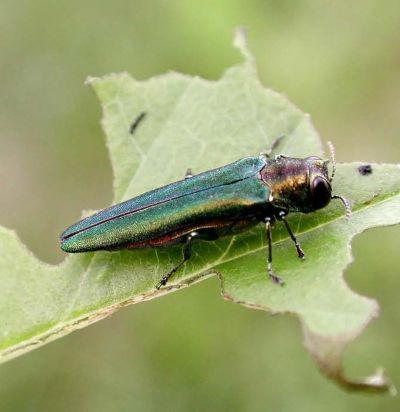
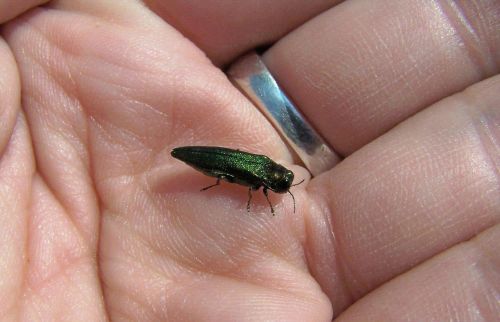
Image 1. Adult size Emerald Ash Borer (EAB) Photos (top): Debbie Miller, USDA Forest Service, Bugwood.org; (bottom): Marianne Prue, Ohio Department of Natural Resources – Division of Forestry, Bugwood.org |
Arborists, foresters, and tree enthusiasts in Montana have no doubt heard of the looming insect threat found in neighboring states. Emerald Ash Borer (EAB), Agrilus planipennis, is an iridescent green beetle whose beautiful appearance belies its potential for widespread destruction of its host, true ash (Fraxinus spp.) trees. Tragically, EAB has killed millions of ash trees across the eastern and midwestern U.S. over the past two decades.
Native to Asia, EAB is thought to have been introduced to North America in the 1990s, likely on solid wood packing material. It was formally detected in Michigan in 2002 and has spread to at least 38 states and six Canadian provinces. In the West, at the time of writing, EAB is present in eastern North Dakota and South Dakota, northern Colorado, and western Oregon. How likely is it that EAB will be detected in Montana? “Almost certainly,” said Frank Etzler, PhD, Natural Resources Supervisor for the Montana Department of Agriculture. “It’s a matter of when, not if.”
Montana is home to many native and domestic true ash trees. Green ash trees (Fraxinus pennsylvanica) are one of the most planted species in Montana, amounting to 60 percent or more of public trees in some communities. Montana’s native ash trees, found primarily in riparian corridors, are also susceptible to EAB. An infestation in Montana will be costly in the expense of urban tree removal and replacement, as well as the loss of protection from extreme heat and other ecosystem benefits. Early detection is a key component of an integrated approach to slowing the spread of EAB.
IDENTIFICATION
The adult EAB is a roughly ½-inch long, bullet-shaped, metallic green beetle (Image 1). When the wing cases and wings are moved out of the way, a reddish color can be seen on its body (Image 2). There are other green beetles in Montana, but they differ from EAB in their overall body shape or lack the reddish abdomen under the wings (Image 3).
An EAB larva is up to 1½ inches long and is a white-to-cream color with a flattened appearance. Its body segments are bell-shaped, which distinguishes it from other larvae that might be encountered in ash trees (Image 4). Similar-looking larvae found in ash trees in Montana have more rectangular-shaped body segments or have more rounded bodies.


Click on an image to view as a slideshow.
INFESTATION
Adult EAB beetles are active for 3-6 weeks starting in late spring, munching on leaves and laying eggs in the bark of ash trees. Larvae that hatch from these eggs deliver the fatal blow to trees by boring S-shaped tunnels or “serpentine galleries” beneath the bark, disrupting the flow of water and nutrients (Image 5). Infested trees gradually develop signs of distress such as crown dieback and epicormic shoots. But these nonspecific distress signals are also displayed by many non-infested trees in the West due to stressors such as drought, which can confound EAB detection. In large trees, it may take several years of infestation before the beetle’s D-shaped exit holes, about 1/8-inch wide, become visible in the bark of the lower trunk. Other signs of EAB infestation include an increase in woodpecker activity and vertical cracks in the bark where EAB tunneling creates weak spots.
NATIONAL RESPONSE
The beetle can fly many miles in search of a host tree, but people transporting infested firewood or nursery products have served as a significant vector over much longer distances. As such, the initial efforts by the U.S. Department of Agriculture’s Animal and Plant Health Inspection Service (APHIS) focused on quarantine regulations. In early 2021, however, APHIS rescinded those regulations to refocus federal resources on biocontrol agents. Biocontrol uses several species of parasitoid wasps that are natural enemies of the EAB to reduce its numbers. These wasps grow and feed in the eggs or larvae of the EAB, leading to its demise. Millions of parasitoid wasps have already been released in impacted states. Offspring of the parasitoid wasps have subsequently been recovered, pointing to the parasitoid wasps’ ability to establish themselves in new environments. Biocontrol has likely slowed but not eliminated the spread of EAB and is just one component of an integrated pest management approach. Other important tools include ongoing public education about not transporting infested ash products (learn more at dontmovefirewood.org), early detection practices, and treating infested trees with injectable insecticides.
MONTANA READINESS AND RESPONSE
To date, the EAB has not been detected in Montana. Infested firewood is considered the most probable route of introduction to Montana, since visiting recreationists often bring firewood from out-of-state. Like some other states, Montana implemented a state quarantine order (MTQ-2021-001) after APHIS rescinded the federal quarantine. It prohibits the import of untreated ash nursery stock and other ash products (such as firewood and logs that have not been heat-treated).
Although agencies have experimented with monitoring EAB traps across the state, stressed ash trees are typically more attractive to the beetle than the volatile compounds in the traps. As such, experts believe that EAB will be initially detected here in a symptomatic tree. But it is important to remember that even healthy-appearing trees can be infested. Since 2015, the Department of Natural Resources and Conservation (DNRC) has recommended routine surveillance of both symptomatic and asymptomatic ash trees for the EAB by a process known as ‘destructive sampling.’ In destructive sampling, two live, mid-crown branches (2-3 inches in diameter at the base) are properly pruned from the tree, and a 20-inch section at the basal end is peeled using a draw knife or similar tool to whittle off thin sections. The presence of S-shaped tunnels, which can be quite small and may contain larvae, is indicative of infestation. More detailed instructions and photographs of the destructive sampling technique have been published on the Idaho Department of Lands Forest Health website and in a technical bulletin from the Canadian Forest Service.
In 2025, the multi-agency State of Montana Emerald Ash Borer Readiness and Response Plan was published, delineating a coordinated protocol for initial detection and identification of EAB (Figure 1). Tree professionals and other members of the public who suspect the presence of EAB or have collected a suspected EAB specimen should contact their local MSU Extension agent or the Schutter Diagnostic Lab at Montana State University. A comprehensive response to a confirmed infestation encompasses the latest research-based practices, which currently include cutting and chipping infested trees, kiln-drying infested board material, treating living trees with pesticides as part of the “Slow Ash Mortality” or SLAM approach, and working with APHIS to determine if releasing biocontrol wasps is appropriate.
|
Emerald Ash Borer Initial Detection and Identification Protocol |
|---|
|
|
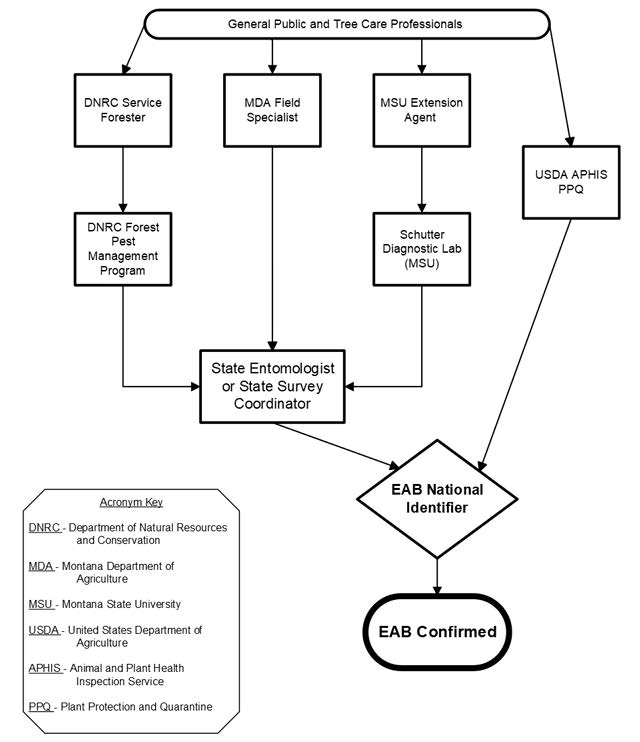
Figure 1. State of Montana Emerald Ash Borer Readiness and Response Plan (2025).
Frank Etzler, Natural Resources Supervisor, Montana Deptartment of Agriculture.
In the meantime, it is sensible to stop planting new ash trees. Municipalities can explore funding sources (particularly from the Montana DNRC) to diversify an urban forest. Local MSU Extension agents can assist Montanans with selecting alternative tree species and scouting for EAB in their communities. Find a local agent on the MSU Extension website at montana.edu/extension or contact Schutter Diagnostic Lab entomologists with specific questions on EAB identification by email at insects@montana.edu, or by calling 406-994-5704.
Chloe Louise Rice is the MSU Schutter Lab Arthropod Diagnostician; Jennifer Swanson
is an MSU Extension agent in Teton County.