

Agricultural Plastics are a Recyclable Solid Waste
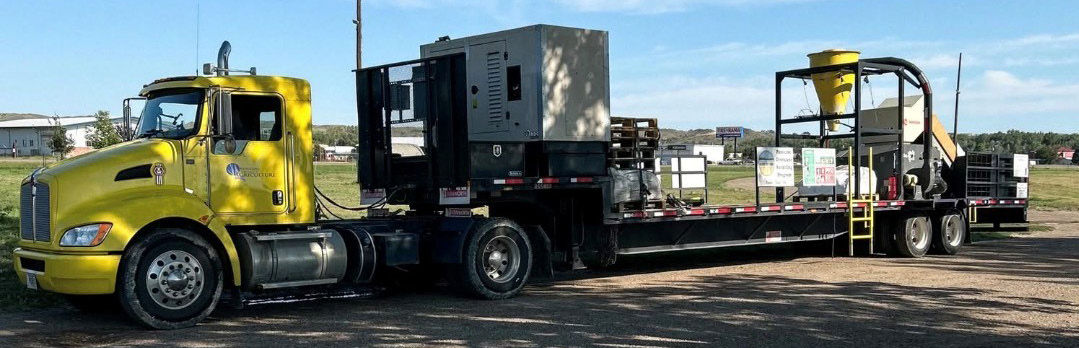
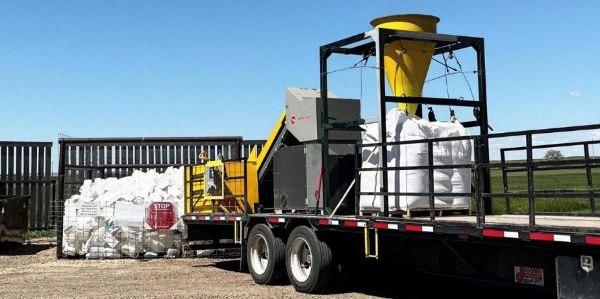
Photos (top and bottom): Montana Department of Agriculture
In the early 2000s, agricultural chemical suppliers faced a crisis that had been steadily gathering in Montana. The Green Revolution of the 1960s-80s increased crop yields globally, and since then, the agronomic sciences have steadily advanced in soil nutrition, pest management, and plant genetics. Food production in Montana has continued to increase and diversify. According to the USDA National Agricultural Statistics Service, in 2025, the average Montana yield per acre was 34 bushels of wheat, compared with the 1959 average of 19 bushels. The average acre of Montana wheat in 2025 can provide flour for approximately 1,400 loaves of bread. This food production increase often relies on a global supply chain of fertilizer inputs and chemical pesticides that arrive in a lot of packaging. The crisis facing Montana’s food production industry was the slow accumulation of used chemical containers and waste pesticides that were no longer legal to use or had expired and spoiled.
The history of chemical packaging follows closely with developments in material science through the 1900s. Liquids were often shipped in glass or tin containers, and solids or powders were packaged in paper boxes, burlap sacks or wood kegs. The fragile nature of the packaging lent itself to easier disposal, but it could react with the chemical contents or break during shipping. This led to a high risk of personal exposure and environmental contamination, as well as difficulty in handling and application.
Photo: AdobeStock
High-density polyethylene plastic (HDPE) was developed in the early 1950s, and the #2 resin code was added in the late 1980s to designate it as a recyclable plastic. It has ideal properties for agricultural chemical containers. HDPE, or #2 plastic, is resistant to chemical solvents and ultraviolet radiation and is a very lightweight, durable material that doesn’t shatter or easily crack. Based on agricultural chemical sales data, it is estimated that over 120,000 pounds of plastic containers are utilized annually in Montana’s agriculture industry. The human health and environmental risks associated with agricultural chemicals make the safe disposal of containers and waste material costly and often inaccessible to most Montanans.
In 2009, the State of Montana recognized the lack of access and opportunity for farmers to safely recycle used agricultural chemical containers and dispose of waste pesticides and established section 80-8-111 of the Montana Code Annotated: Waste pesticide and pesticide container collection, disposal, and recycling program. This law directs the Montana Department of Agriculture to establish a waste pesticide disposal and pesticide container recycling program.
The use of agricultural containers to store anything other than the labeled product is prohibited by law. Agricultural chemical containers must be rinsed clean of any product within 24 hours of being emptied, and federal law requires that containers be free of any product before disposal at a landfill or acceptance by a recycling program. Pesticide containers (HDPE #2) entering landfills or being recycled must be triple-rinsed or power-washed prior to being punctured and rendered unusable. Applicators often utilize rinse basins or specialized nozzles to rinse containers as they are emptied into mixing tanks. Rinse water containing low concentrations of pesticides or fertilizers, resulting from cleaning containers and application equipment, can be dispersed according to the manufacturer’s product label guidelines.
Despite these precautions, it is difficult to ensure all containers are clean when entering the waste stream. Thus, recyclable plastic from agricultural chemical containers must be kept separate from domestic plastic recycling programs, and agricultural chemical container plastic cannot be recycled into new containers for any purpose. Instead, agricultural plastic is recycled into products like shipping pallets, field drainage tile, buried electrical conduit, rebar chairs (used to set rebar in concrete), lawn edging, trail signs, etc.
The agricultural chemical container recycling program in Montana is possible due to the support of the Ag Container Recycling Council (ACRC). The ACRC is a not-for-profit 501(c)(6) trade association that works to facilitate the collection and recycling of one-way rigid HDPE agricultural pesticide plastic. This is achieved through member funding. Since 2009, the Montana program has diverted 970,332 pounds of agricultural plastic from local landfills and is on track to reach one million pounds of recycled plastic in 2026.
For the safety of recycling staff, it is required that all agricultural chemical containers be emptied of all product, triple rinsed and dried, with foil seals and label booklets removed. Larger agricultural chemical containers like 30-and 50-gallon drums are accepted but must be cut into 1/8 sections to fit into the granulator. Plastic totes and crate containers, measuring cups, spray wands, and pumps are not accepted.
Two new regional agricultural container recycling granulators are open at the Lake County Weed Control Office in Polson and the Daniels County Solid Waste facility in Scobey. These are the first infrastructures of their kind in Montana, providing greater access to agricultural plastic recycling. These new installations augment the mobile grinding unit, a yellow Kenworth truck pulling a generator and plastic granulator on a 40-foot trailer. Nicknamed “Russell,” the plastic grinder makes scheduled visits to locations across Montana. To see when Russell will be in your area, visit the Montana Department of Agriculture’s Pesticide Container Recycling Program seasonal schedule.
To participate in the pesticide container recycling program:
- Triple rinse or powerwash HDPE #2 pesticide plastic containers.
- Remove lids, labels, foil liner, and booklet from the outside of containers.
- Visit the MDA webpage agr.mt.gov/Pesticide-Programs and click ‘container recycling’ for more information and a schedule of collection events.
- Bring containers to the collection day and drop them off free of charge.
Brett Heitshusen is the Sustainable Agriculture Section Supervisor with the Montana
Department of Agriculture.