

2025 Water Quality Report
Prepared for Montana State University by the City of Bozeman Water Treatment Plant
Pure and Fresh
We are pleased to present our 2025 Water Quality Report for MSU-Bozeman. We want to inform you about the water we deliver everyday.
Through a cooperative effort between MSU-Bozeman and the City of Bozeman, all required monitoring and reporting is conducted by the City of Bozeman Water Treatment Plant operators to ensure MSU-Bozeman’s drinking water meets, or exceeds, all established federal and state water quality standards.
The water system for MSU-Bozeman had zero violations for 2025. The report informs you about the quality of drinking water delivered each day. It contains a list of all detected contaminants found in MSU-Bozeman’s drinking water and information on the water sources.
The sources of drinking water (both tap water and bottled water) include rivers, lakes, streams, ponds, reservoirs, springs, and wells. As water travels over the surface of the land or through the ground, it dissolves naturally-occurring minerals and, in some cases, radioactive materials, and can pick up substances resulting from the presence of animals or from human activity.
Contaminants that may be present in source water include:
- Microbial contaminants, such as viruses and bacteria, which may come from sewage treatment plants, septic systems, agricultural livestock operations, and wildlife.
- Inorganic contaminants, such as salts and metals, which can be naturallyoccurring or result from urban stormwater runoff, industrial or domestic wastewater discharges, oil and gas production, mining or farming.
- Pesticides and herbicides, which may come from a variety of sources such as agriculture, urban stormwater runoff, and residential uses.
- Organic chemical contaminants, including synthetic and volatile organic chemicals, which are by-products of industrial processes and petroleum production, and can also come from gas stations, urban stormwater runoff, and septic systems.
- Radioactive contaminants, which can be naturally-occurring or be the result of oil and gas production and mining activity.
Water Sources
Montana State University-Bozeman is a consecutive system to the City of Bozeman. This means all drinking water for MSU-Bozeman comes from the City of Bozeman Water Treatment Plant. The sources of the City of Bozeman’s drinking water are the following:
Hyalite Creek
The water from Hyalite Creek flows into the Middle Creek Reservoir (Hyalite Reservoir) where it is stored for current and future use. This is a surface water source.
Sourdough Creek
The creek water is drawn from the watershed in Sourdough Canyon. No storage reservoir exists since the breaching of Mystic Lake Dam in 1985. This is also a surface water source.
Water from Hyalite Creek is diverted via an underground pipeline and is mixed with water from Sourdough Creek at the City of Bozeman Water Treatment Plant located on Sourdough Canyon Road.
The Sourdough and Middle Creek water sources are utilized at a 22 million gallon per day (MGD) microfiltration membrane plant with robust pretreatment. This plant allows the City to meet the service demands and comply with the Environmental Protection Agency (EPA) and Montana Department of Environmental Quality (MTDEQ) regulations.
Source Water Assessment
Bozeman’s watersheds are devoid of significant potential sources of contamination. The exception is the transportation corridor along Hyalite Creek, which has a high susceptibility to contamination by transportation of chemicals, especially vehicle fluids on Hyalite Road.
Water & Your Health
In order to ensure that tap water is safe to drink, EPA prescribes regulations which limit the amount of certain contaminants in water provided by public water systems. FDA regulations establish limits for contaminants in bottled water which must provide the same protection for public health.
Drinking water, including bottled water, may reasonably be expected to contain at least small amounts of some contaminants. The presence of contaminants does not necessarily indicate that water poses a health risk. More information about contaminants and potential health effects can be obtained by calling the Environmental Protection Agency’s Safe Drinking Water Hotline (800-426-4791).
Some people may be more vulnerable to contaminants in drinking water than the general population. Immuno-compromised persons such as persons with cancer undergoing chemotherapy, persons who have undergone organ transplants, people with HIV/AIDS or other immune system disorders, some elderly, and infants can be particularly at risk for infections. These people should seek advice about drinking water from their health care providers. EPA/CDC guidelines on appropriate means to lessen the risk of infection by Cryptosporidium and other microbial contaminants are available from Safe Drinking Water Hotline (800-426-4791).
For More Information
Jac Miller, Assistant Superintendent
City of Bozeman - Public Works, Water Treatment Plant
406.994.0501 - WTP@bozeman.net - www.bozemanwater.com
Visit www.bozeman.net/waterquality for the City of Bozeman's Water Quality Report
Definitions and Table of Contaminants
Chlorine and Fluoride are added and pH is adjusted by the City of Bozeman Water Treatment Plant as water exits the treatment plant. Chlorine is added to maintain a measurable chlorine residual throughout the entire distribution system. The chlorine residual is measured daily in the MSU-Bozeman distribution system. Fluoride is naturally occurring in nearly all water. Fluoride is dosed to meet EPA requirements. It is measured daily in the MSU-Bozeman distribution system. The pH is adjusted for corrosion control of lead and copper piping. The target pH is between 8.00 and 8.60 depending on the time of year. The pH is measured daily in the MSU-Bozeman distribution system. Total Trihalomethanes and Haloacetic Acids are measured at the Miller Dining Complex and the Plew Building. They are measured quarterly as part of the MSU-Bozeman distribution system for compliance with the Stage 2 Disinfection Byproducts Rule.
* Lead sampling was performed in June 2024 for MSU-Bozeman. If present, elevated levels of lead can cause serious health problems, especially for pregnant women and young children. Lead in drinking water is primarily from materials and components associated with service lines and home plumbing. MSU-Bozeman is responsible for providing high quality drinking water, but cannot control the variety of materials used in plumbing components. When your water has been sitting for several hours, you can minimize the potential for lead exposure by flushing your tap for 30 seconds to 2 minutes before using the water for drinking or cooking. If you are concerned about lead in your water, you may wish to have your water tested. Information on lead in drinking water, testing materials, and steps you can take to minimize exposure is available from the Safe Drinking Water Hotline or at http://www.epa.gov/safewater/lead. MSU has no known lead service lines remaining; more information on the MSU service line inventory is available online through ArcGIS here.
| Action Level (AL): | The concentration of a contaminant which, if exceeded, triggers treatment, or other requirements, which a water system must follow. Ninety percent of samples must be at, or below, this level. Lead and copper are measured at the 90th percentile. |
| Maximum Contaminant Level (MCL): | The highest level of a contaminant allowed in drinking water MCLs are set as close to MCLGs as feasible, using the best available treatment technology. |
| Maximum Contaminant Level Goal (MCLG): | The level of a contaminant in drinking water below which there is no known or expected risk to health. MCLGs allow for a margin of safety. |
| Maximum Residual Disinfectant Level (MRDL): | The highest level of a contaminant allowed in drinking water. There is convincing evidence that addition of a disinfectant is necessary for control of microbial contaminants. ( 4.0 mg/L) |
| Maximum Residual Disinfectant Level Goal (MRDLG): | The level of a drinking water disinfectant below which there is no known or expected risk to health. MRDLGs do not reflect the bene- fits of the use of disinfectants to control microbial contaminants. (4.0 mg/L) |
| Nephelometric Turbidity Units (NTU): | The level of turbidity in filtered water. |
| ppm and ppb: | Parts per million and parts per billion |
| pCi/L: | Picocuries per liter (a measure of radioactivity) |
| uS/cm | microsiemens per centimeter |
| Treatment Technique (TT): | Required process intended to reduce the level of a contaminant in drinking water. |
| Running Annual Average (RAA): | Average of the results of the most recent four quarters. |
| Locational Running Annual Average (LRAA): | Average of the results for a location of the most recent four quarters. |
| UCMR | Unregulated Contaminant Monitoring Rule |
| Variances and Exemptions | State or EPA permission not to meet an MCL or a treatment technique under certain conditions. |
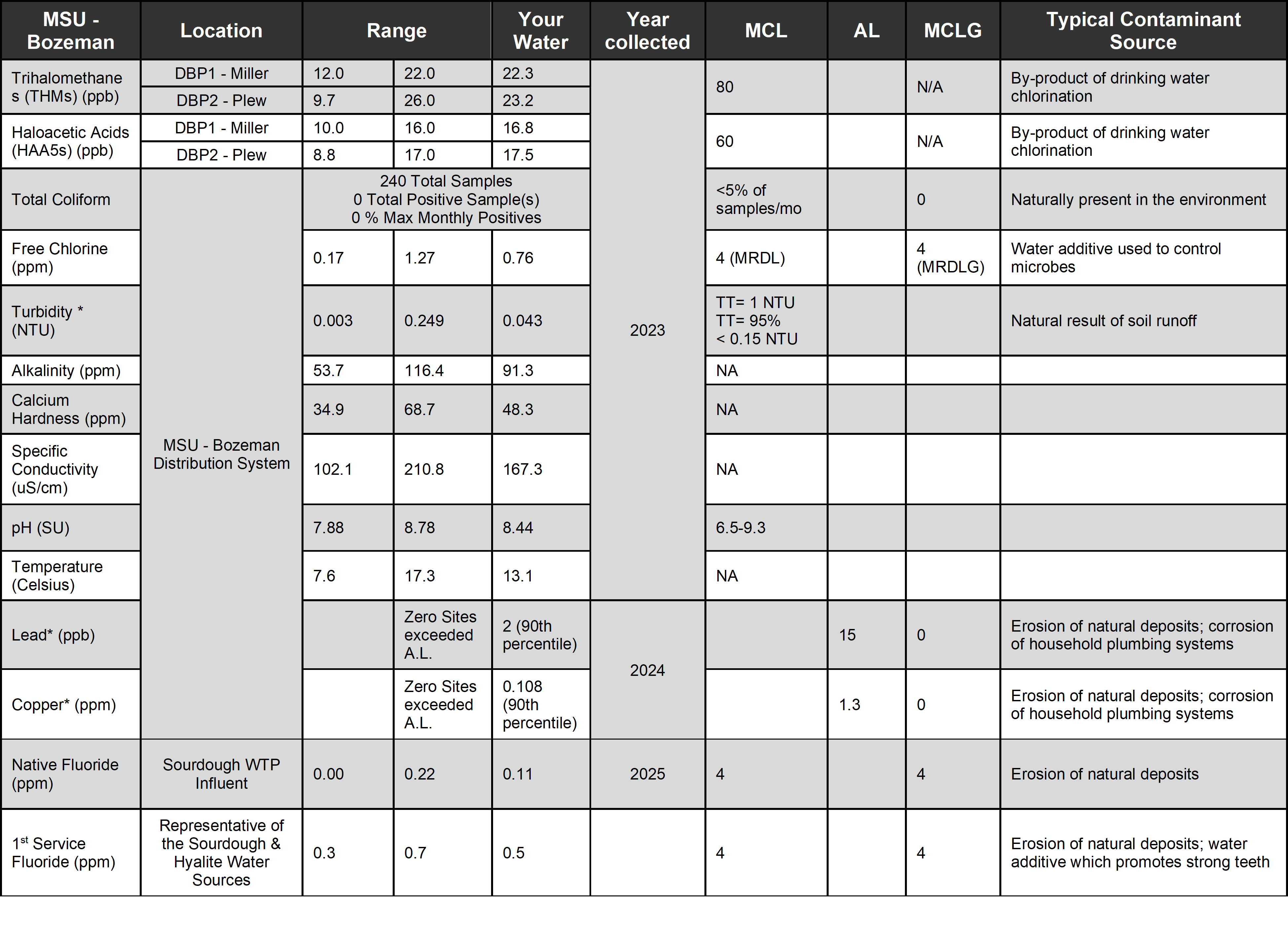
*Lead has not been detected in Bozeman’s source water. City of Bozeman sampling was
done February through March of 2022 in accordance with EPA regulations. Lead and Copper
are regulated over the entire distribution system (not by source) so these results
are not repeated for the Lyman Source.
**Turbidity has no health effects. However, turbidity can interfere with disinfection
and provide a medium for microbial growth. The City of Bozeman’s filtered water must
be less than, or equal to, 0.15 NTU in at least 95% of monthly measurements, and it
can never exceed 1 NTU. The single highest measurement was 0.044 NTU. Bozeman’s average
daily turbidity was 0.017 NTU.