

A Quick Guide to Irrigated Agriculture in Montana
Although irrigation makes up only a small share of Montana’s agricultural land, it’s
good for ninth place in nationwide irrigated area.
January 2, 2026
By Nick Hagerty
Source: https://stock.adobe.com Pete Hoffman
Recently I was curious about some basic facts around irrigated agriculture in Montana.
Now, irrigation doesn’t play as big of a role in our state’s agricultural sector as
some other states around the West like Idaho or Colorado. But it’s still quite important,
especially in certain communities like the Hi-Line, those along the Yellowstone River,
and valleys around Western Montana.
But exactly how big is irrigated agriculture in Montana? Compared with non-irrigated
agriculture, in terms of land area? Or in terms of dollars? Compared with other sectors,
in terms of water use? It was surprisingly hard to find basic statistics, so I decided
to pull together some numbers myself.
Many of these statistics were only recently made possible to calculate, thanks to
the U.S. Department of Agriculture’s 2023 Irrigation and Water Management Survey. Keep in mind there are flaws and limitations in all data sources, and my calculations
have to make some assumptions and approximations. Still, this is the best available
information, so far as I’m aware. (And if you think I’m missing anything, please contact
me and let me know!)
1. How much irrigated land is irrigated?
Between 1.6 and 1.7 million acres, according to the 2023 IWMS or the 2022 Census of
Agriculture. That includes 1.2 million acres of cropland and 370,000 acres of pastureland.
Irrigated cropland makes up 7.4% of all cropland, or 11% of harvested cropland (although
probably not all irrigated cropland is harvested). Irrigated pasture is 1% of all
pastureland.
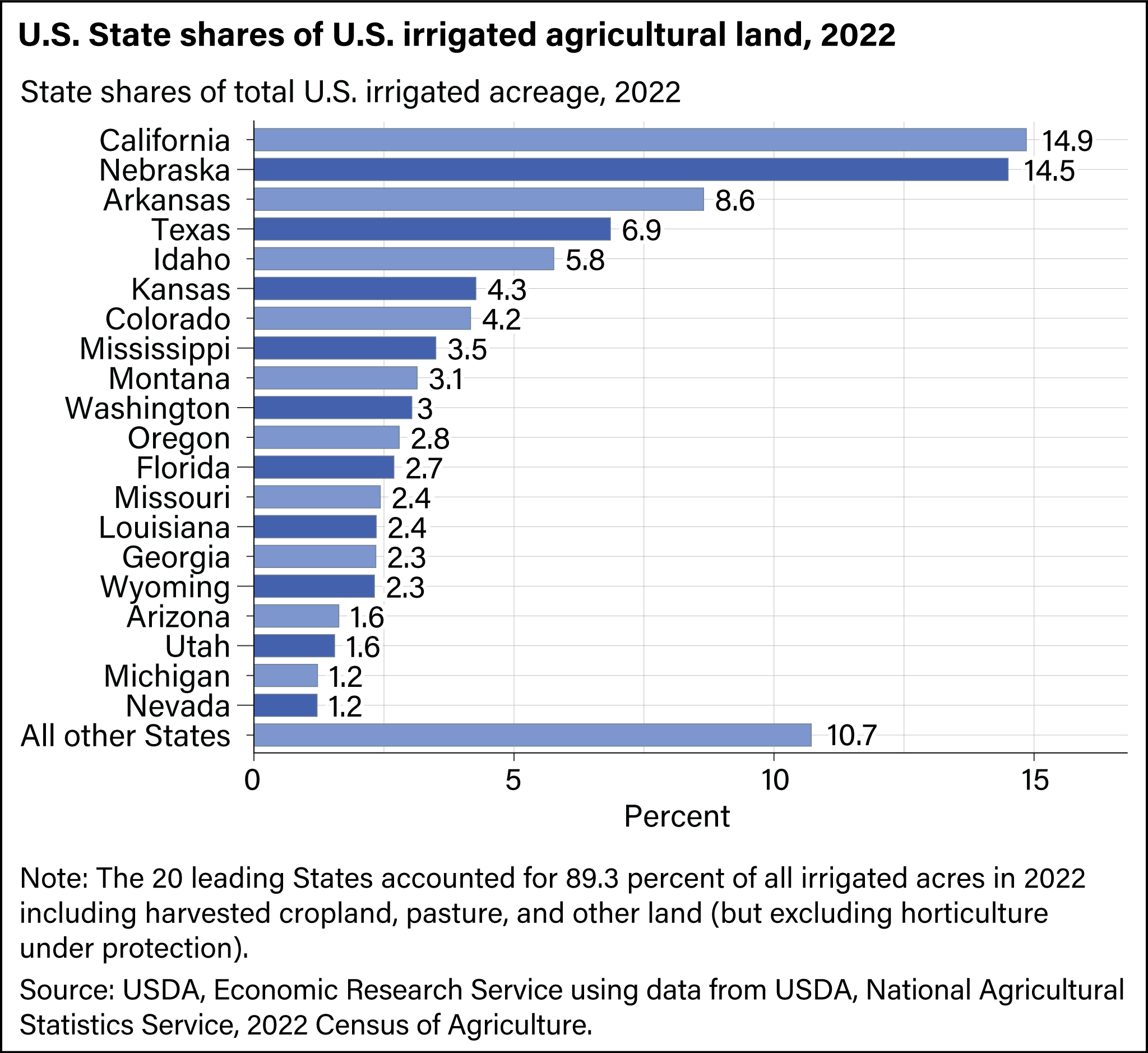
Those look like small percentages, but Montana is so big that they put us on the national
leaderboard for irrigated land area – in ninth place. This graph from the USDA shows
that Montana makes up 3% of all irrigated acreage nationwide. Excluding wetter states
in the East, Montana has the seventh-most irrigated acreage in the country.
2. Where is the irrigated agriculture in Montana?
Instead of statistics, I recommend using this link to see a map of the DNRC’s handy Montana Statewide Irrigation Dataset. In western
Montana, the answer is in valleys. In eastern Montana it’s highly concentrated along
certain rivers, particularly the Yellowstone and its tributaries and the Milk River.
3. What crops are irrigated?
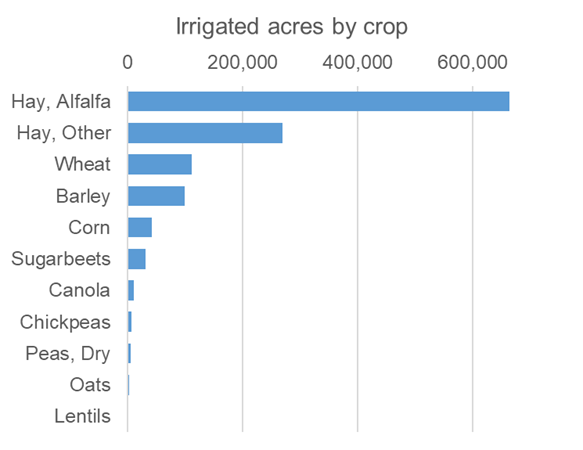
One way to ask this question is: Which crops have the most irrigated area? The answer is generally hay, as seen in the graph below (which uses data from the 2022 Ag Census). Alfalfa is the single crop with the most irrigated acres – it makes up more than half of all irrigated cropland in Montana. In other words, if you see a random field with irrigation equipment, the crop is more likely than not to be alfalfa. And three out of four irrigated acres are growing some type of hay (including both alfalfa and other types like grass). Most of the rest are wheat and barley.
Source: Graph created by Nick Hagerty, Montana State University, Department of Agricultural Economics and Economics
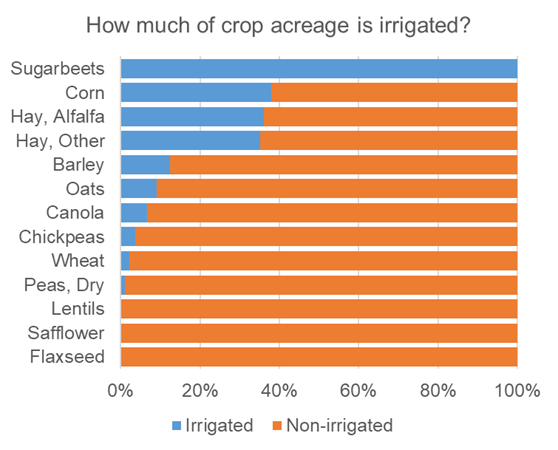
A very different way to ask this question is: Which crops are most likely to be irrigated? Although most irrigated acres are hay, most acres of hay are not irrigated! Only
36% of hay acreage is irrigated. The only crop in Montana that’s mostly irrigated
is sugarbeets. In fact, 100% of sugarbeets are irrigated. All other crops are mostly
not irrigated.
Source: Graph created by Nick Hagerty, Montana State University, Department of Agricultural Economics and Economics
Note this is just in terms of land area – it is still possible that most hay production is irrigated! Fields that are irrigated can get more cuttings per year, so higher
yields per acre can make up for fewer acres.
So that’s Montana’s irrigated agriculture in terms of land area. What about in terms
of economic value? In my next post, I’ll show some new calculations about how important
irrigation is to Montana’s agricultural sector in terms of production and revenue.

Nick Hagerty
Assistant Professor
nicholas.hagerty@montana.edu
Montana State University is an ADA/EO/AA/Veteran’s Preference Employer and Provider of Educational and Outreach.